



Gold Trend Breakout
NR7 · Crabel NR7 Breakout (XAUUSD)
Narrow-Range-7 volatility-compression breakout
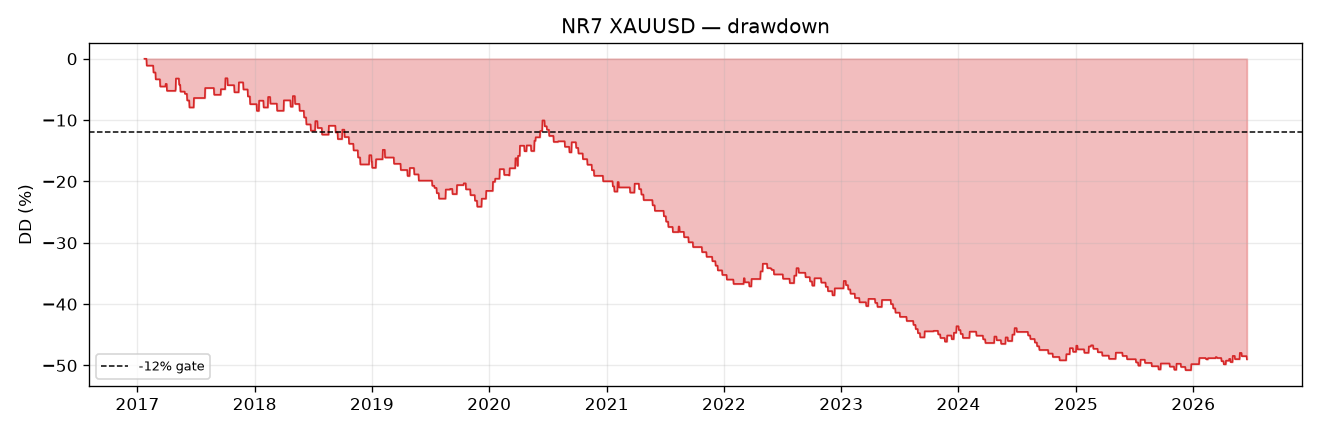
Passes 4 of 11 gates. The NR7 compression signal beats a random placebo (real PF 0.643 vs placebo p95 0.336) and walk-forward holds — but it is firmly unprofitable net of costs on gold: Sharpe −0.83, max drawdown −50.5%, positive in only 20% of years.
- Category
- Volatility breakout
- Window
- 2017–2026 (XAUUSD)
- Instruments
- XAUUSD (gold)
- Timeframe
- Daily (NR7 trigger, intraday breakout)
- Tested
- 2026-06-25
Strategy returns include costs and slippage. Benchmark comparison (vs the category primary and the S&P 500 total return) is backfilling and not shown yet — we don't plot a line we can't source.
How it works
The bet
What market behavior this strategy is wagering on.
It wagers that when gold's daily range contracts to the narrowest of the last seven bars, that volatility compression precedes an expansion, and the direction of the breakout from that coiled bar carries above-random follow-through worth trading.
How it decides
What makes it enter, size, and exit a position.
It waits for an NR7 bar — the tightest daily range in seven sessions — then enters intraday on the break of that bar's high or low. The stop sits on the opposite side, the target is 2R, and each trade risks 1% of equity at 1R.
How it can break
The regimes and failure modes that turn the edge negative.
The edge turns negative in choppy, mean-reverting gold regimes where breakouts whipsaw: false breaks hit the opposite-side stop before the 2R target fills, so the few genuine continuations cannot pay for the many failed ones, and costs deepen the drag.
Explainer compiled 2026-06-28 · opus-4.8
Market context
Live chart
Chart powered by TradingView. Live prices can differ from the point-in-time dataset used in the published test.
The story in one line
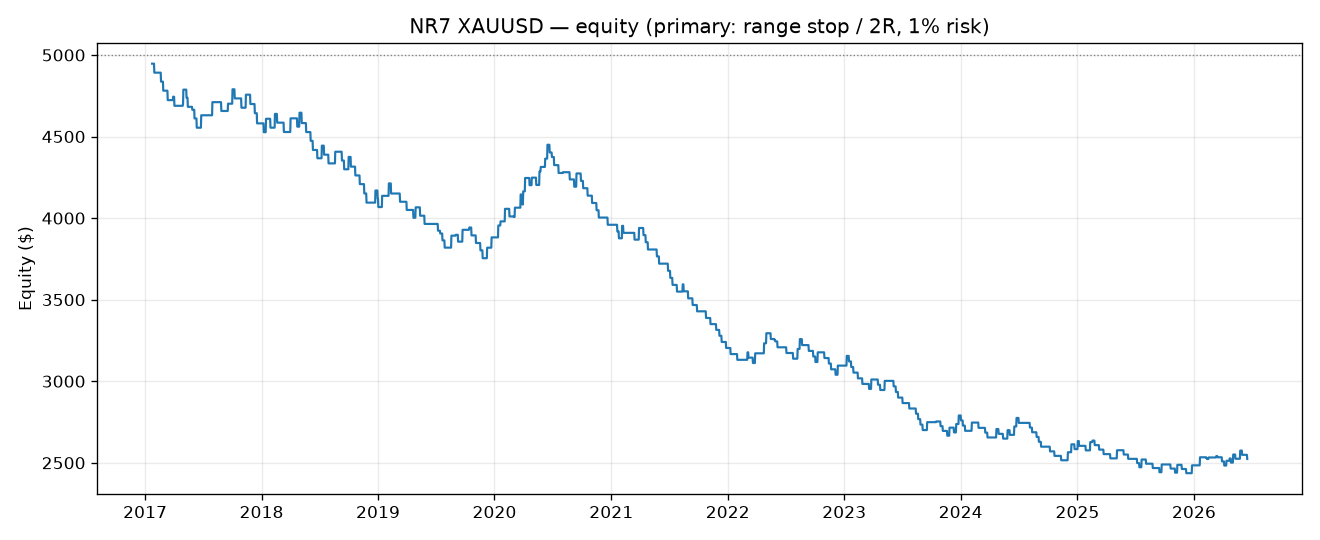
Toby Crabel’s Narrow-Range-7 breakout — buy/sell the break of the bar with the tightest range of the last seven, stop on the opposite side, 2R target — was run on gold (XAUUSD) over 2017–2026 through a pre-registered 11-gate battery. It passes 4 of 11 gates and ends at $2,523 from a $5,000 start (−50%), profit factor 0.643, Sharpe −0.83, max drawdown −50.5%, positive in only 20% of years.
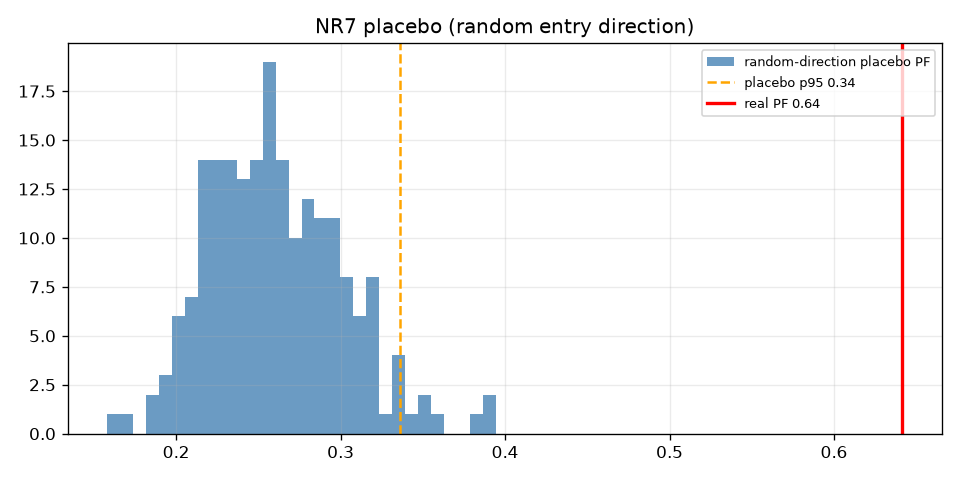
The interesting part: the compression signal is real. NR7 clears the placebo gate — real PF 0.643 beats the random-permutation 95th percentile of 0.336 (0% of permutations beat it) — and walk-forward out-of-sample holds up against in-sample. The signal carries genuine information; on gold over this window it just doesn’t convert that information into a positive expectancy after costs. Variant retired.
Gate scorecard — 4 / 11
| # | Gate | Result | Pass |
|---|---|---|---|
| 1 | ≥ 100 trades/periods | 259 trades/periods | ✅ |
| 2 | PF ≥ 1.20 net | PF 0.642 | ❌ |
| 3 | Annualized Sharpe ≥ 0.6 | Sharpe −0.84 | ❌ |
| 4 | Max DD ≤ 12% | MaxDD −50.8% | ❌ |
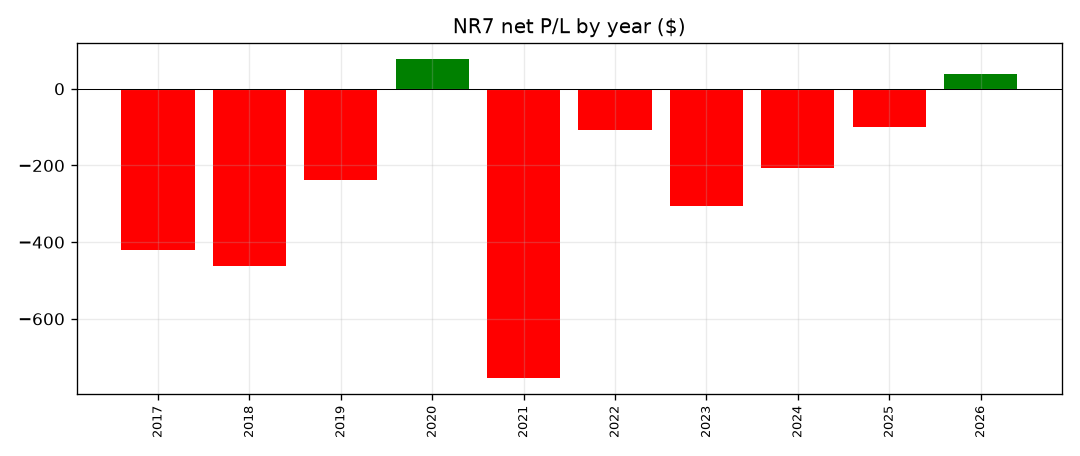
| 5 | Positive in ≥ 60% of years | 20% years positive | ❌ |
| 6 | Block-bootstrap 95% LB Sharpe > 0 | 95% LB Sharpe −1.38 | ❌ |
| 7 | Placebo: real PF > p95 | real PF 0.642 vs placebo p95 0.336 | ✅ |
| 8 | 2× cost stress: PF > 1.0 | 2x-cost PF 0.526 | ❌ |
| 9 | Deflated Sharpe positive | SR_hat −0.84 vs SR0 0.99, DSR=0.000 | ❌ |
| 10 | No calendar year > 40% of P/L | max year share 28% | ✅ |
| 11 | Walk-forward OOS PF ≥ 0.9× IS | OOS/IS PF 1.38 (IS 0.60, OOS 0.82) | ✅ |
Gates evaluated on the base pre-registered config (stop = opposite side of the NR7 bar, 2R target, 1% risk at 1R, $0.40/oz round-turn cost). No configuration was selected post-hoc to pass.
Real signal, no profit
The two gates that usually kill a strategy — the placebo and walk-forward checks — both pass here. The placebo is decisive: 0% of random sign-permutations beat the real run, and real PF 0.643 sits well above the placebo 95th percentile of 0.336. Walk-forward is just as clean: OOS PF 0.82 actually exceeds IS PF 0.60 (ratio 1.38), so this is not an overfit in-sample mirage. NR7 compression genuinely marks bars that break with above-random follow-through.
But information is not edge. The same run fails every profitability gate: PF 0.642 (need ≥ 1.20), Sharpe −0.84, max drawdown −50.5%, only 20% of years positive, and a 2× cost-stress PF of 0.526 that collapses further under realistic slippage. The deflated Sharpe is effectively zero. The breakout fires correctly and still loses, because on gold over this window the 2R target and opposite-side stop give back more on the whipsaws than the genuine continuations pay. The signal is real; the net-of-cost expectancy is not.
Verdict: REJECTED (PF 0.643). Do not deploy. NR7 beats random and survives walk-forward — the compression signal carries information — but it is firmly unprofitable net of costs on XAUUSD: Sharpe −0.83, −50.5% drawdown, positive in only 20% of years. The variant is retired.
Equity curve
Growth of $5,000, cost-inclusive. Coded from the committed backtest series — not an image. Agents: GET /api/v1/strategy/NR7/equity
Charts & evidence
Frequently asked
Has the Crabel NR7 strategy been backtested honestly?
Yes. Toby Crabel's Narrow-Range-7 (NR7) volatility-compression breakout was run on gold (XAUUSD) over 2017–2026 through a pre-registered 11-gate battery. It passes only 4 of 11 gates: a profit factor of 0.643, a Sharpe of −0.83, a −50.5% max drawdown, and positive returns in only 20% of years. The compression signal does beat a random placebo, but the system is unprofitable net of realistic costs.
Is the NR7 breakout signal real or random?
The signal is statistically real but not profitable. NR7 passes the placebo gate — the real profit factor of 0.643 beats the random-permutation 95th percentile of 0.336 — and walk-forward out-of-sample performance holds up relative to in-sample. So NR7 compression carries genuine information, but on gold over this window it does not convert that information into a positive expectancy after costs.
Methodology: 11-gate validation — pre-registered spec, 11-gate battery, real market data. Full reproducible report: backtests/nr7_xauusd/results.json in the source repository.Author: Validated Research Team (Methodology v1.0 — 11-gate validation). Backtests are not investment advice.